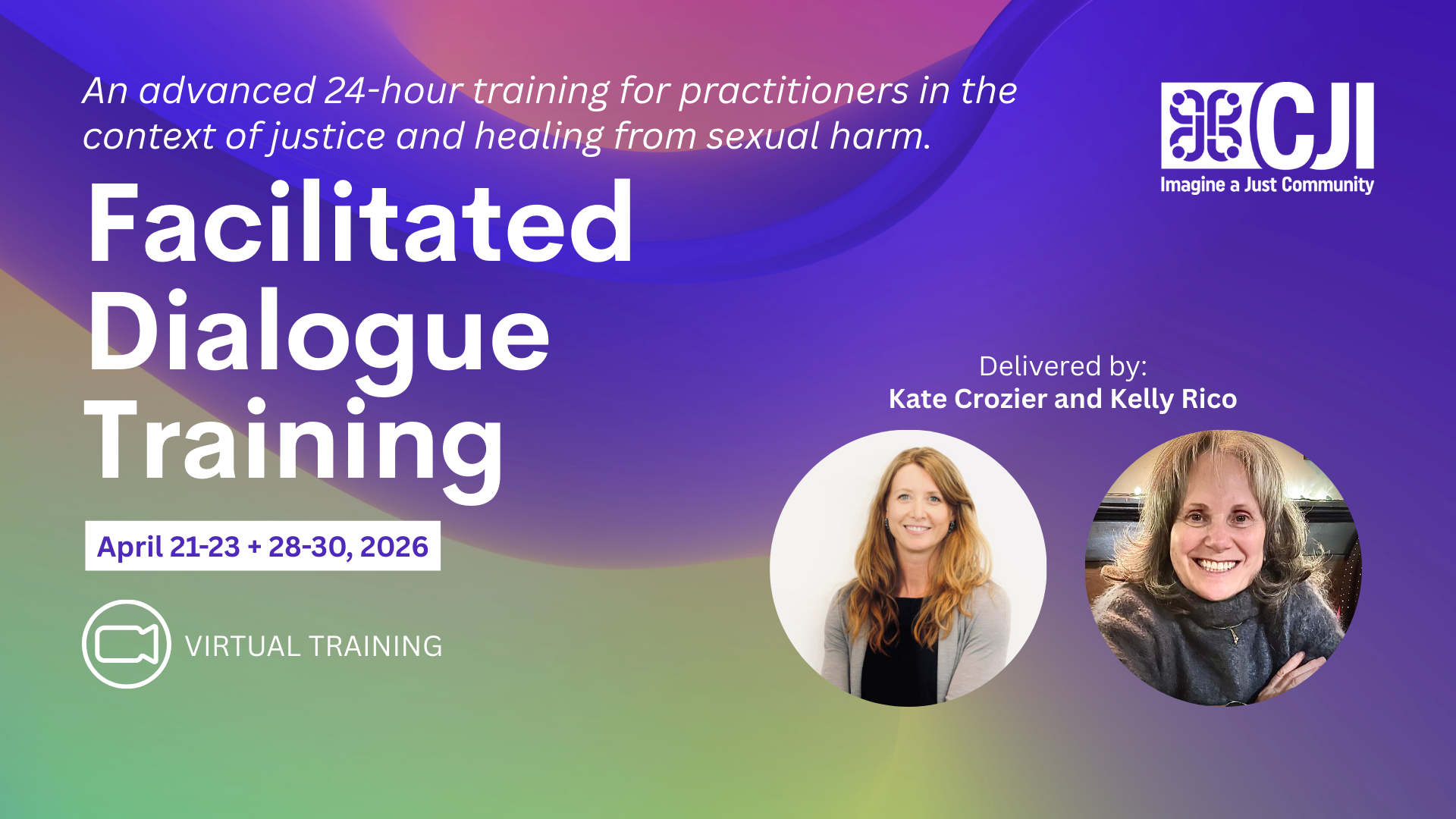

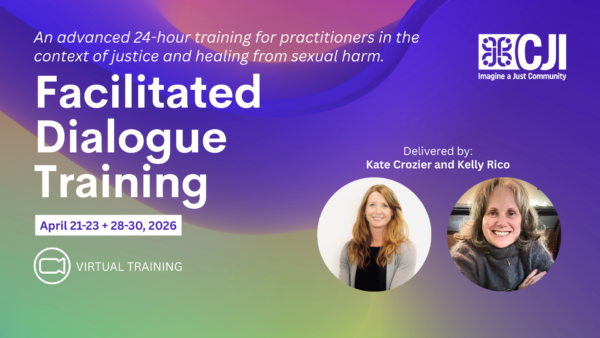
Facilitated Dialogue Training for Sexual Harm (Virtual) April 21-23 + 28-30, 2026 1:00pm-5:00pm EST each day
An advanced 24-hour training for practitioners committed to restorative justice in the context of justice and healing from sexual harm
Facilitated Dialogue (FD) is the core model our agency uses to support survivors of sexual harm who wish to engage in a restorative process with the person(s) who harmed them. This training is designed for practitioners who are ready to deepen their skills and who intend to use restorative justice specifically in situations of sexual harm. It is not a training about whether restorative justice is appropriate for sexual violence; instead, it teaches how to steward this work ethically, safely, and with great care.
Grounded in restorative justice values and shaped by trauma-informed, survivor-centered practice, Facilitated Dialogue expands on Transformative Mediation and basic understanding of sexual harm to meet the unique relational, emotional, and systemic complexities of sexual harm. Participants learn how to accompany people impacted by sexual harm including survivors and those who have caused harm as well as others impacted like family or friends through a rigorous, multi-stage process that centers choice, readiness, accountability, and safety.
Developed for practitioners with foundational mediation experience and trauma-informed training, this program offers a rare opportunity to learn a specialized approach used across individual, family, workplace, and community contexts. It also acknowledges the truth of this work: Facilitated Dialogue is a practice that requires ongoing reflection, mentorship, and skill stewardship. This training is an entry point into a deeper discipline, not a standalone qualification.
Through group learning, individual reflection, case examples, structured observation, and immersive role-play, participants gain a working understanding of the FD model—from first contact to preparation, dialogue, and follow-up—even as they continue developing the judgment required for real-life cases.
What the Training Covers
- The values and commitments that ground Facilitated Dialogue
- The full FD process and its application to cases of sexual harm
- Building relationships of trust: meeting participants and assessing readiness
- Case development with survivors
- Case development with those who have caused harm
- Dialogue facilitation and follow-up
- Safety planning and risk management throughout the process
- How to move forward when dialogue is not appropriate or not possible
- Skill practice through role-plays and observation
- Considerations for mentorship and real-world application
Who This Training Is For
This training is designed for practitioners who:
- have foundational knowledge of Transformative Mediation (or equivalent),
- have familiarity and experience working with sexual harm and/or gender-based violence
- have experience with trauma-informed support, and
- are seeking to build the specific skills needed to practice restorative justice in situations of sexual harm.
This training is required for all Revive Facilitated Dialogue volunteers.’
If you questions or concerns around if this training is right for you, connect with Revive Program Coordinator, Julie Schelter at [email protected].
Tax Receipts: CJI does not provide a tax letter as we are not a recognized educational organization. This does not mean you cannot claim the expense. It depends on each individual’s situation, which can be addressed by a tax accountant.
Withdrawal/Refund Policy: Pre-paid registrants may receive a refund, less a $100.00 administrative fee, if notice is received in writing (letter, email) four weeks prior to the start date of a workshop. If notification is received less than four weeks prior to the start date no refund is issued. However, credit may be applied toward another date or workshop. A $100.00 administrative fee is applied to a transfer in dates.
Non –Attendance: Non-attendance of a registrant at a workshop without notification does not constitute withdrawal and no refund or transfer is applicable. If notification is provided in writing (letter, email) four weeks prior to the commencement of a workshop transfer is permitted within a one year period. Consideration will be made for “exceptional” circumstances (illness, compassionate grounds). Please note that a $100.00 administrative fee applies to all transfers.
Cancellation Policy: CJI reserves the right to cancel any workshop due to unforeseen circumstances.
Absenteeism/Class Attendance: As professionals who are interested in co-creating a high quality learning experience, we know that your commitment to the workshop includes attending all of the training dates. Because we are committed to offering a professional program, we need to ensure that individuals who receive our certificates have actually covered the full curriculum.
Transfer: Transfers are dependent upon availability of space in a workshop. A $100.00 administrative fee applies for a transfer of part of a workshop to another date.
Please note: early bird rate ends March 24, 2026 at which point tickets will be $999
Meet the Trainers
 Kate Crozier
Prior to working at CJI, Kate spent most of her career working with women impacted by violence. She has spent 20 years working to address the impacts of gender-based violence through a mix of feminist anti-violence work which included counselling, advocacy, practical support and restorative justice work. Both of these fields of work have fed her interest in tackling both personal and systemic issues through non-carceral pathways. Kate brings to this training, 7+years of experience working with and training others in Facilitated Dialogue as well as a depth of experienced working with survivors, people who have caused sexual harm and their families. Throughout this time, she has provided supervision to FD practitioners and fellow trainers. In addition to supporting the team at CJI, Kate offers coaching to the leadership team for a restorative justice organization in Australia.
 Kelly Rico
 I came to restorative justice in 2009 following more than a decade of lay work in addiction recovery. There, experiencing how community fosters a genuine and sustainable healing justice made restorative justice a natural fit. I first interned with Community Justice Initiatives’ Revive program between 2009 – 2010 as part of Queen’s University’s Restorative Justice Diploma program. As a survivor, I was laser-focused on being part of (then very rare) initiatives that provided spaces for those who harmed to assume accountability in human-centred ways. I was transformed by the people and the work at CJI and have been volunteering with Revive ever since as co-facilitator with the PWOS program (People Who Offend Sexually), with Survivor Circles, and with the Facilitated Dialogue program. My current role with CJI is supporting practitioners at Transforming Justice Australia as they evolve their first national program for restorative justice and sexual harm. I also hold a Diploma in Conflict Analysis and Mediation (Conrad Grebel College) and a Masters in Human Security and Peacebuilding (Royal Roads University). My MA thesis explored restorative justice applications for conflict-related sexual violence in Colombia’s peace process. I was a community of practice member with the Courage to Act project that developed a roadmap for university administrators to work restoratively with people who have caused harm in campus settings. I am currently a restorative practitioner with Canada’s Department of National Defence. I am also a formal student with the New York Zen Center for Contemplative Care, a practice that helps deepen the embodied, heart-centred work inherent in restorative justice. I love this work and have a profound faith – based in real evidence, with real people – that when we create and hold a space of trust, patience, honesty, care, and presence, we can transform lives out of some of the most acute harm. It is always a joy to share this work and to support others in their own journey with it.
Events
List of events in Photo View
-
-
Facilitated Dialogue Training April 21-23 + 28-30, 2026 (Virtual)
April 21 @ 1:00 pm - April 30 @ 5:00 pmGet Tickets $100.00 – $950.00 -
-
Revive Group Facilitation Training May 12 – June 23 (Weekly, In-Person)
May 12 @ 6:00 pm - June 23 @ 9:00 pm -
Transformative Mediation Training May 19-22, 2026 (In-Person)
May 19 @ 8:30 am - May 22 @ 4:30 pm -
Transformative Mediation Training November 18-20 + 24-27 2026 (Virtual)
November 18 @ 8:30 am - November 27 @ 12:30 pm