Community Justice Initiatives Waterloo Region is proud to share the findings of our Identity-Based Harm Prevention Project, a community-informed initiative that explored how identity-based harm affects people across the Waterloo Region and identified opportunities for prevention, intervention, and after-care.
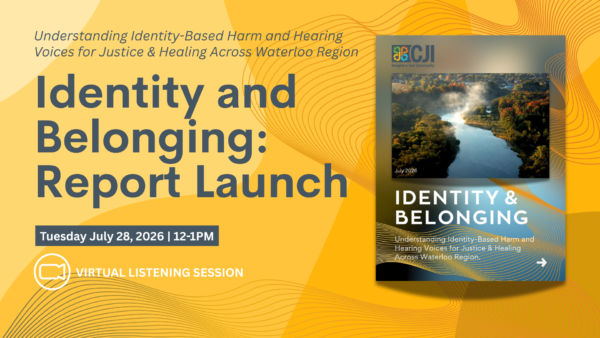
YOU’RE INVITED: Join us on Tuesday July 28th from 12-1pm for a virtual MEET THE REPORT session where project leads Jamie and Kamil will introduce you to the project, its questions, findings, calls to action and leave some room for your reflections. REGISTER TO RECIEVE A ZOOM LINK.
Social polarization is deepening, perceptions of the “the other” are hardening, and across Waterloo Region, identity-based harm is leaving lasting impacts not only on those directly targeted, but on entire communities who see themselves reflected in the harm – shaping the safety, wellbeing, and sense of belonging across the fabric of our communities.
As restorative justice practitioners who have been offering intervention services in local cases of identity-based harm for several years, we know that harm and crime targeting identity is alive and well. Still, we recognized significant gaps in what we know about identity-based harm in the Waterloo Region. Namely, what needs around justice and healing exist? What should or could accountability look like? What efforts towards prevention are felt as significant by those with lived experience?
We connected with community members through an anonymous public survey, a service provider survey, and circle-style group dialogues held in collaboration with community partners. Altogether, we heard from nearly 300 community members and service providers.
Participants told us that identity-based harm is common and deeply impactful. Participants also highlighted the importance of education, community investment, and systemic change in preventing harm before it occurs.
We heard a consistent message throughout the project: healing happens in community. Participants spoke about the importance of being heard, supported, and connected, and many emphasized that meaningful justice extends beyond formal legal processes.
“Healing is being heard… it’s communal.”
The project concludes with a series of calls to action for criminal legal professionals, educators, workplaces, restorative & community justice practitioners, and social service organizations. Ultimately, these calls to action advance our collective goals to prevent identity-based harm and foster a safer, more responsive Waterloo Region.
CJI extends its sincere gratitude to OK2BME, the YMCA of Three Rivers, and Interfaith Grand River for partnering to facilitate community dialogues, as well as to every community member and service provider who generously shared their experiences, perspectives, and expertise.
The full project report and one-page summary will be available on CJI’s website on July 28 and will provide a comprehensive overview of the findings and recommendations. CJI looks forward to continuing working alongside community partners to facilitate collective action, strengthen capacity, and cultivate the conditions that support healing, belonging, and safety throughout the Waterloo Region.
Conducted from October 2025 to June 2026, the project was funded by the Region of Waterloo Upstream Fund and led by Jamie Armstrong, Project Coordinator, and Kamil Ahmed, Director of Partnerships and Knowledge Mobilization at CJI.